Telangana LRS: Layout Regularisation Explained for Plot Buyers
How Telangana's Layout Regularisation Scheme (LRS) works, why LRS status matters when buying a plot in an unapproved layout, and where to verify it officially.
If you are looking at a plot in an older layout in or around Hyderabad — or anywhere in Telangana — you will sooner or later meet the term LRS. It stands for Layout Regularisation Scheme, the state's mechanism for regularising plots in layouts that were carved up and sold without formal planning approval. Whether a plot is approved, regularised, pending regularisation, or none of these changes what you can legally do with it, so it is worth understanding the mechanics before you commit.
What an unapproved layout is
In Telangana, anyone subdividing land into plots for sale is required to obtain layout approval from the planning authority with jurisdiction — the Hyderabad Metropolitan Development Authority (HMDA) within its metropolitan area, other urban development authorities in their areas, and the Directorate of Town and Country Planning (DTCP) elsewhere. An approved layout carries a Layout Permission (LP) number and must meet planning norms: road widths, earmarked open space, and conformity with the master plan.
An unapproved layout is one where plots were sold without this approval ever being taken. Large numbers of such layouts exist across the state, particularly on former agricultural land on urban fringes. The plots in them may have perfectly valid registered sale deeds — registration of a deed and planning approval of a layout are two separate systems — but the layout itself was never sanctioned.
What LRS 2020 actually is
The current scheme is the Layout Regularisation Scheme 2020, notified through G.O.Ms. No. 131 of the Municipal Administration and Urban Development Department, dated 31 August 2020. Its mechanics, in brief:
- It applied to plots in unapproved layouts that already had a registered sale deed on or before 26 August 2020 — the scheme's cut-off date. Plots sold after that date were not eligible, and an agreement of sale or GPA was not accepted in place of a registered deed.
- Both individual plot owners and layout owners or developers (for entire layouts) could apply. A layout owner was eligible to apply for the unsold plots only if at least 10 per cent of the layout's plots had been sold through registered deeds by the cut-off date. The application fee was Rs. 1,000 for an individual plot owner and Rs. 10,000 for a layout developer covering the entire layout.
- Regularisation charges were prescribed with reference to the plot's extent and the registration department's market value: a basic charge per square metre set by plot-size slab, scaled from 25 per cent to 100 per cent of that figure according to the sub-registrar market value of the land as on 26 August 2020, plus pro-rata open-space charges where the layout lacked the mandated 10 per cent open space.
- Applications are decided by the Competent Authority defined under the scheme — the Commissioner of GHMC within GHMC limits, the Municipal Commissioner in other municipal corporations and municipalities, and the District Collector or Additional Collector (Local Bodies) for gram panchayat areas. Note that HMDA and DTCP, which approve new layouts, are not the sanctioning authorities under LRS.
- The application window closed on 31 October 2020 (the original deadline of 15 October 2020 was extended). Check the official LRS portal for the current status of the scheme and of any application.
- Processing of the large backlog of applications filed in 2020 was taken up again under government guidelines issued in July 2024, so applications from that window are being scrutinised, approved with conditions, or rejected on an ongoing basis.
A crucial nuance: an application filed in 2020 is not the same as regularisation. Under the rules, mere pendency of an application is not deemed approval — a plot is regularised only when the Competent Authority issues proceedings approving the application and the prescribed charges have been paid. If the charges are not paid within the time the authority allows, regularisation is not considered and the plot continues to be treated as unauthorised. "LRS applied" and "LRS approved" are very different statuses.
What LRS cannot do
LRS is a planning regularisation, not a title certificate. It does not cure defects in ownership, resolve disputes, or validate a forged document chain. It also excludes certain land outright: plots falling in water bodies, Full Tank Level (FTL) and buffer zones, government land, or land reserved in the master plan for roads or other public uses are not regularisable, whatever the seller says. Title and encumbrance checks remain entirely your responsibility.
Why LRS status matters to you as a buyer
- Building permission. Authorities do not grant building permission on a plot in an unapproved layout unless it has been regularised (or the layout is approved). An unregularised plot is, in practice, a plot you cannot lawfully build on.
- Registration of resale. The government orders accompanying LRS 2020 directed that plots in unapproved layouts should not be registered for sale going forward. A plot without approval or regularisation can therefore face friction at the sub-registrar's office when you try to buy it — or later resell it.
- Lending. Banks and housing finance companies routinely ask for layout approval or LRS proceedings before financing plot purchase or construction.
- Pending liability. If the seller filed an LRS application but never paid the charges, that liability effectively travels with the plot. You need to know the exact status and who will bear the cost of completing it.
Where to check
- LRS application status: the state's LRS portal (lrs.telangana.gov.in) has an application search — ask the seller for the application number and check the status yourself.
- Approved layouts: HMDA publishes approved-layout records under its Planning section on hmda.gov.in; for areas outside HMDA, check with DTCP (dtcp.telangana.gov.in) or the local urban body. Ask for the LP number and verify it against the authority's records, not just the brochure.
- Encumbrance certificate: obtain an EC for the plot through the Registration and Stamps Department (registration.telangana.gov.in) to see the registered transaction history.
- New plotted ventures: plotted developments above the statutory threshold require registration with Telangana RERA — search the project on rera.telangana.gov.in before paying anything for a newly launched venture.
What to check before you pay
- Is the layout approved with an LP number? Verify the number with HMDA or DTCP records directly.
- If unapproved, was an LRS application filed before the 2020 deadline? Get the application number and check the live status on the LRS portal.
- If the application shows approved, ask for the proceedings copy and proof that regularisation charges were paid.
- Confirm the applicant's name matches the current title holder shown in the sale deed and encumbrance certificate.
- Rule out FTL, buffer-zone, government-land or master-plan-reserved locations, which LRS cannot regularise.
- For a new venture, confirm RERA registration on the state RERA portal.
LRS status is a checkable fact, not something to take on a seller's word. Verify every document on the relevant official portal and consult a qualified property lawyer before you transact.
Official Sources
- Telangana Layout Regularisation Scheme (LRS) official portal — application search and scheme documents
- Telangana State Portal press release: Expedite LRS Scheme-2020 (Feb 2024)
- HMDA Planning section — layout approvals and approved-layout records
- Directorate of Town and Country Planning, Telangana (layout approvals outside HMDA)
- Telangana Registration and Stamps Department — encumbrance certificates and deed registration
- Telangana RERA — project registration search for plotted ventures
Rules and portals change — always confirm the current position on the official site before you transact.
Questions Buyers Ask
Is an LRS application the same as regularisation?
No. Under the LRS 2020 rules, mere pendency of an application is not deemed approval. A plot is regularised only when the Competent Authority issues approval proceedings and the prescribed charges are paid. An application that is merely filed or pending leaves the plot unregularised, and any unpaid liability effectively travels with the plot.
Does LRS approval prove the seller's title is clear?
No. LRS is a planning regularisation only — it does not cure ownership defects or disputes. You still need to verify the sale deed chain and obtain an encumbrance certificate through the Registration and Stamps Department.
How do I know if a layout is approved rather than regularised?
An approved layout carries a Layout Permission (LP) number from HMDA, another development authority, or DTCP. Verify the LP number against the authority's own records (for example HMDA's Planning section) rather than relying on a brochure.
Who decides an LRS application?
The Competent Authority under G.O.Ms. No. 131: the Commissioner of GHMC within GHMC limits, the Municipal Commissioner in other municipal corporations and municipalities, and the District Collector or Additional Collector (Local Bodies) for gram panchayat areas. HMDA and DTCP approve new layouts but are not the sanctioning authorities under LRS.
Corridor Guides
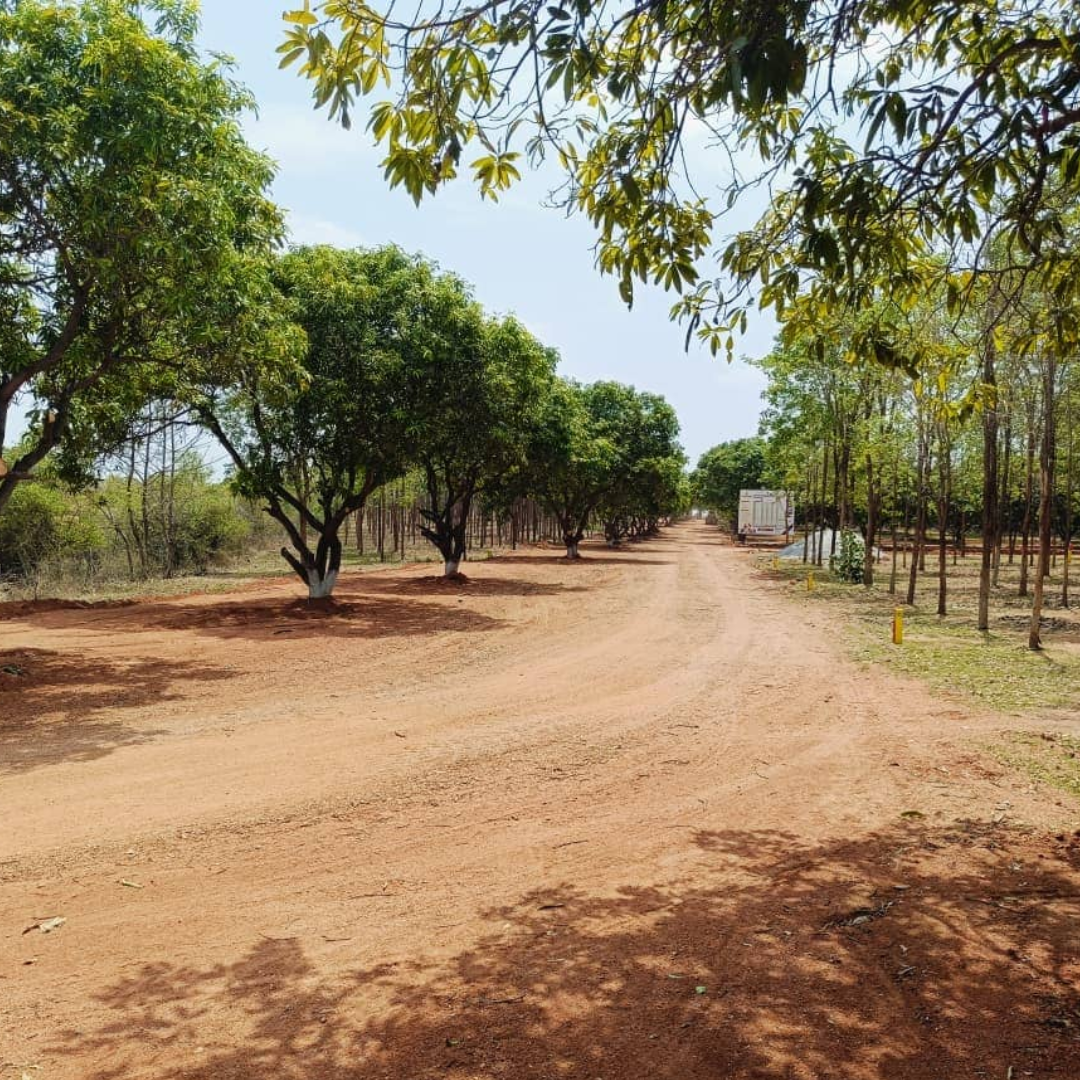 GolanukondaGolanukonda lies in Yadadri-Bhuvanagiri district near the Yadadri temple, connected to the city by the Warangal highway…Explore the corridorYadagiriguttaYadagirigutta is the temple town of the Sri Lakshmi Narasimha Swamy temple (Yadadri), whose large-scale redevelopment has…Explore the corridor
Ask BNR Infra Developers About This
Unsure how this applies to a plot you are considering? Tell us — we reply fastest on WhatsApp.
Buy Safely With BNR Infra Developers
We check the paperwork before we ever show you a plot. Ask us anything — honest answers, fast.